Part of: Why your month-end close keeps getting slower
Single-property hospitality accounting is not complicated. The revenue streams are contained — rooms, F&B, events, spa — and a qualified bookkeeper can manage it. The monthly close at a single property should run five to seven days.
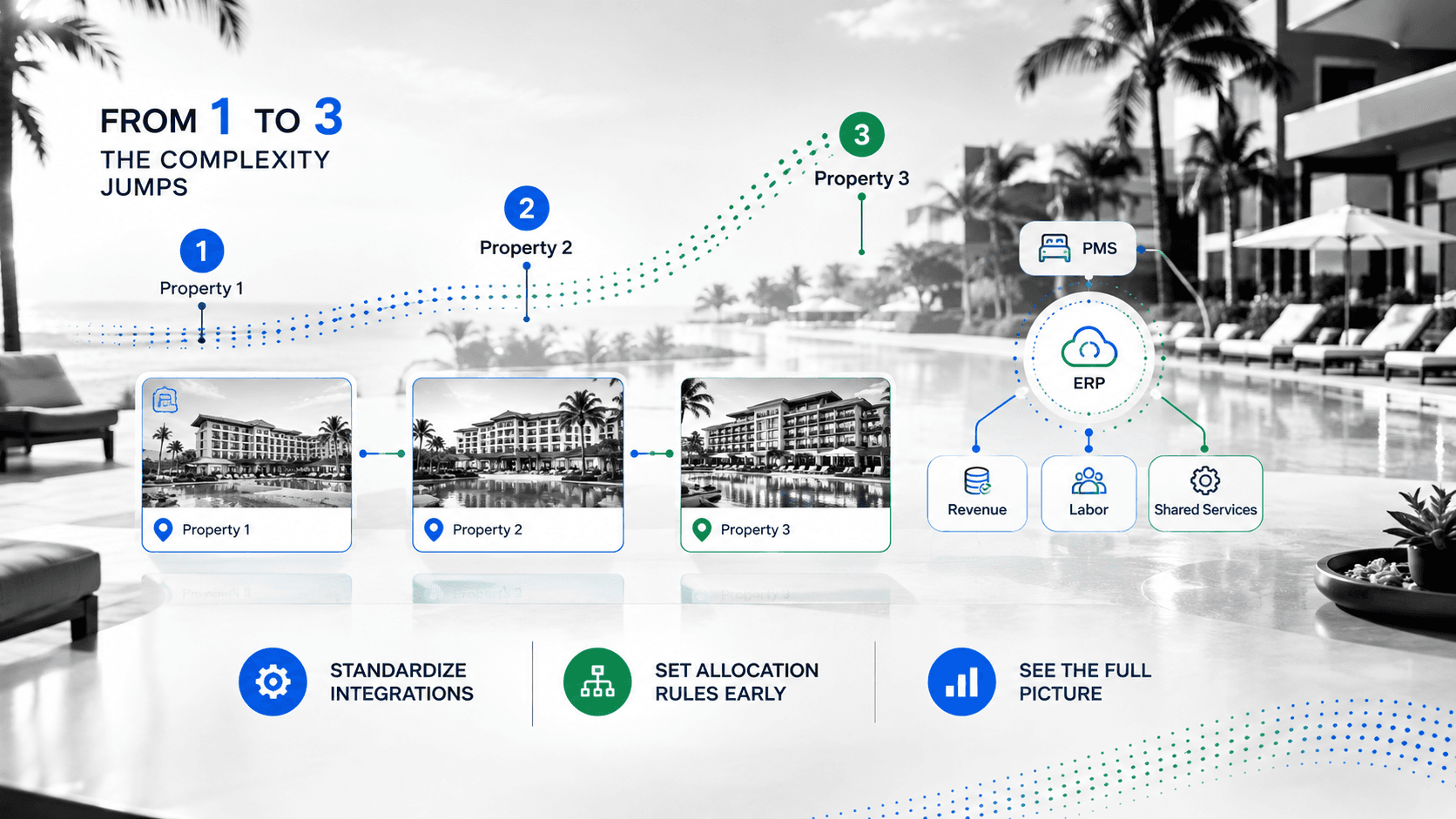
Add a second property and the difficulty increases modestly. Add a third and the accounting function hits a structural transition. This is the pattern I observe consistently across hospitality operators: the business grows to three to five properties and accounting complexity stops growing linearly. It jumps.
What breaks at property three is not volume — it is interoperability. Each property runs its own PMS. The PMS exports to the ERP in slightly different formats. Revenue recognition is handled differently because the rooms manager at property three has a different classification scheme than the one at property one. The labor model does not translate cleanly because the seasonal staff mix is different. Shared services — corporate overhead, group purchasing, brand fees — now allocate across three properties, and the allocation methodology was designed for two.
Three architectural decisions prevent this from becoming a multi-month accounting project every month.
First: standardize the PMS-to-ERP export format across all properties. One integration template, one account mapping, one dimensional structure. Any new property onboards into the same template. Without this, every property is a custom integration and the team supporting five properties supports five different systems.
Second: build shared-services allocation rules in the ERP when the third property is added, not retroactively at property six. The cost of doing it at property three is a few days of configuration. The cost at property six is a reconciliation project across three years of historical data.
Third: produce a consolidated view that includes labor cost by revenue type at the property level. Operators who cannot see rooms labor per occupied room, F&B labor per cover, and events labor per event-hour across all properties are managing margin by feel rather than by system.