Part of: Why your month-end close keeps getting slower
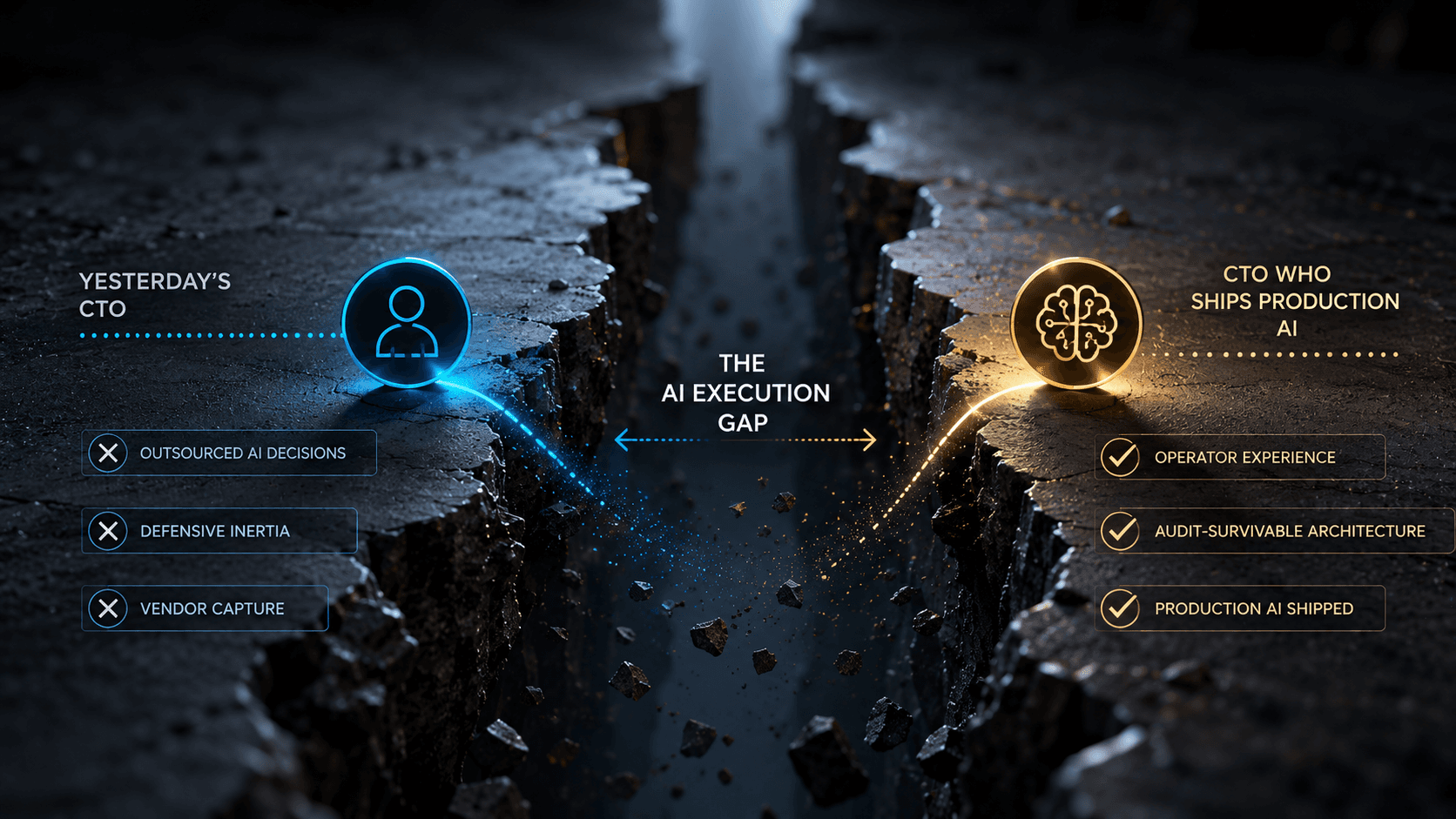
The fractional CTO market in 2026 is full of yesterday's CTOs.
Most did good work between 2015 and 2022 — running engineering teams, modernizing legacy stacks, leading SaaS migrations, building cloud infrastructure. The work was valuable. It is also no longer the work the role needs to cover.
The technology decisions a CFO at a $25M to $100M business is making in 2026 are dominated by AI architecture choices: where the model runs, who owns the orchestration layer, how confidence frameworks integrate with audit requirements, what the build-versus-buy decision looks like at each layer, how production AI integrates with the ERP and the operational systems. A fractional CTO who cannot run these conversations from the operator's chair — who has not personally shipped a production AI deployment with audit-survivable infrastructure — is a liability disguised as a hire.
Three specific failure modes when this gap is present.
Failure mode one — the AI conversation gets outsourced. The fractional CTO defers to a vendor or consultant rather than leading the AI architecture decision. The business is effectively paying a CTO rate for vendor coordination.
Failure mode two — the build-versus-buy decision defaults to buy. A CTO without production AI experience does not know what is genuinely difficult to build and what is genuinely commoditized. The result is expensive custom development for things that should be purchased, or purchased platforms where the business needs custom logic.
Failure mode three — the AI and finance integration conversation never happens. Production AI in finance requires a CTO who can translate between the CFO's operational requirements and the AI architecture that will serve them. Without that translation capability, the AI deployment and the finance system operate in parallel instead of in concert.
The question for any fractional CTO engagement in 2026 is not "have you led technology teams?" The question is "what have you shipped in production, and who is using it today?"
Before you buy another AI seat, find out if your data and process are ready to support it.
Filed under