Part of: Why your month-end close keeps getting slower
The first board meeting determines the CFO's authority for the next twelve months. Most walk in with the wrong frame — prepared to present financials, unprepared for the dynamics that actually determine whether the role becomes strategic or stays operational.
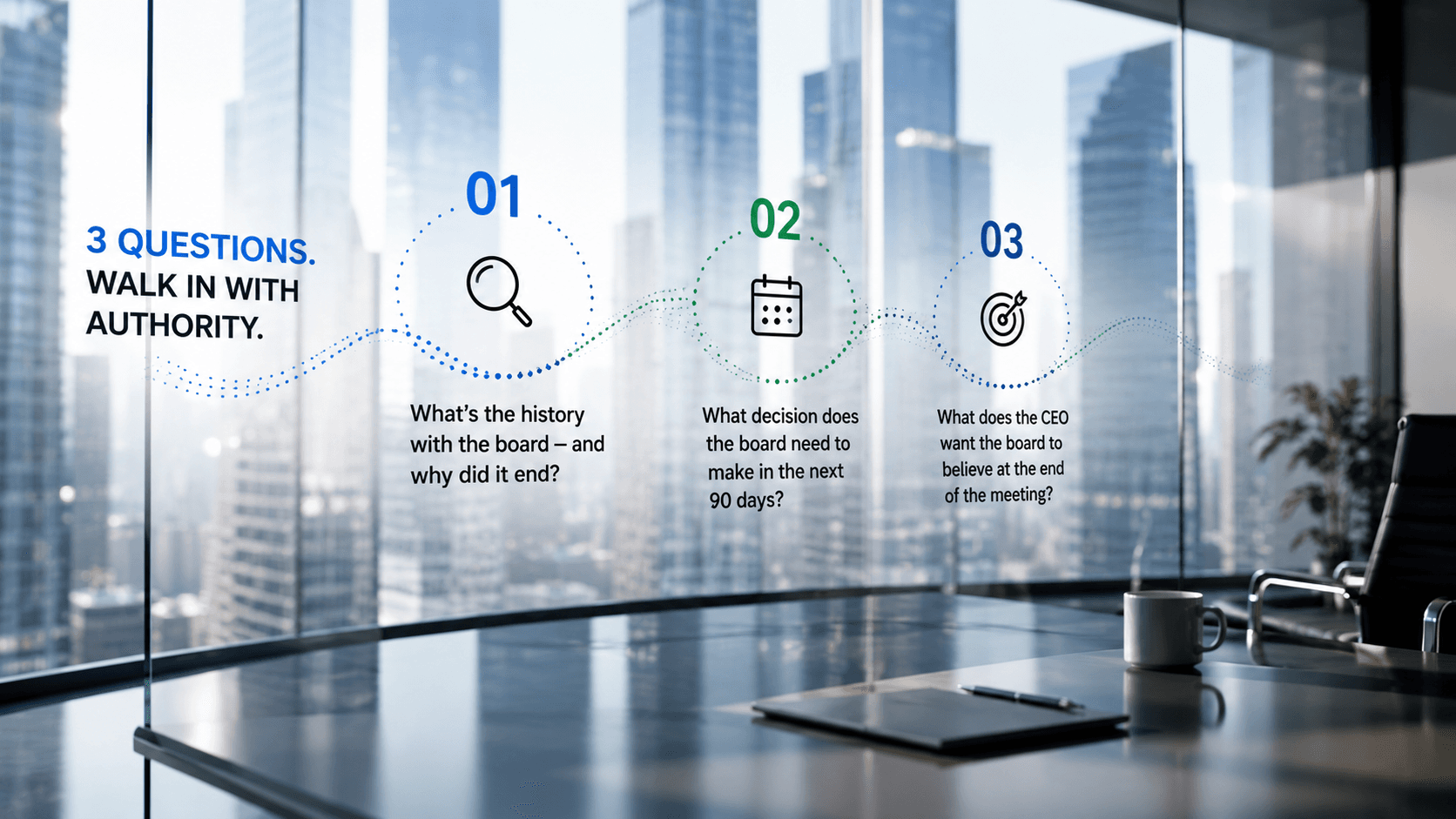
Three questions, asked before the meeting, surface the right frame.
Question one — what did the previous CFO or controller's relationship with the board look like, and why did it end? The current engagement exists for a reason. Sometimes the prior role was eliminated for cost. Sometimes it was performance. Sometimes the board has a specific grievance about reporting cadence, accuracy, or accessibility. The CFO walking in without knowing the previous dynamic is preparing for the wrong meeting. Every board has a memory. If the prior CFO over-presented, the board will be inclined to interrupt. If the prior CFO under-presented, the board will be inclined to dig.
Question two — what decision does the board need to make in the next ninety days? The CFO whose presentation is structured around enabling a specific decision — a credit line renewal, a capital allocation choice, a hiring plan approval — is more useful in the room than the CFO whose presentation reviews the financials without connecting them to a pending decision. Boards do not pay attention to historical data unless it relates to a future decision they need to make.
Question three — what does the CEO want the board to believe at the end of the meeting? The CFO's job in the board meeting is not independent of the CEO's job. If the CEO needs the board to feel confidence about a challenging quarter, the CFO's presentation either supports that or undermines it. Alignment before the meeting determines effectiveness in the meeting.
The operator who can answer all three before the board meeting walks in with authority. The operator who cannot walks in with a deck.
Filed under