Part of: Why your month-end close keeps getting slower
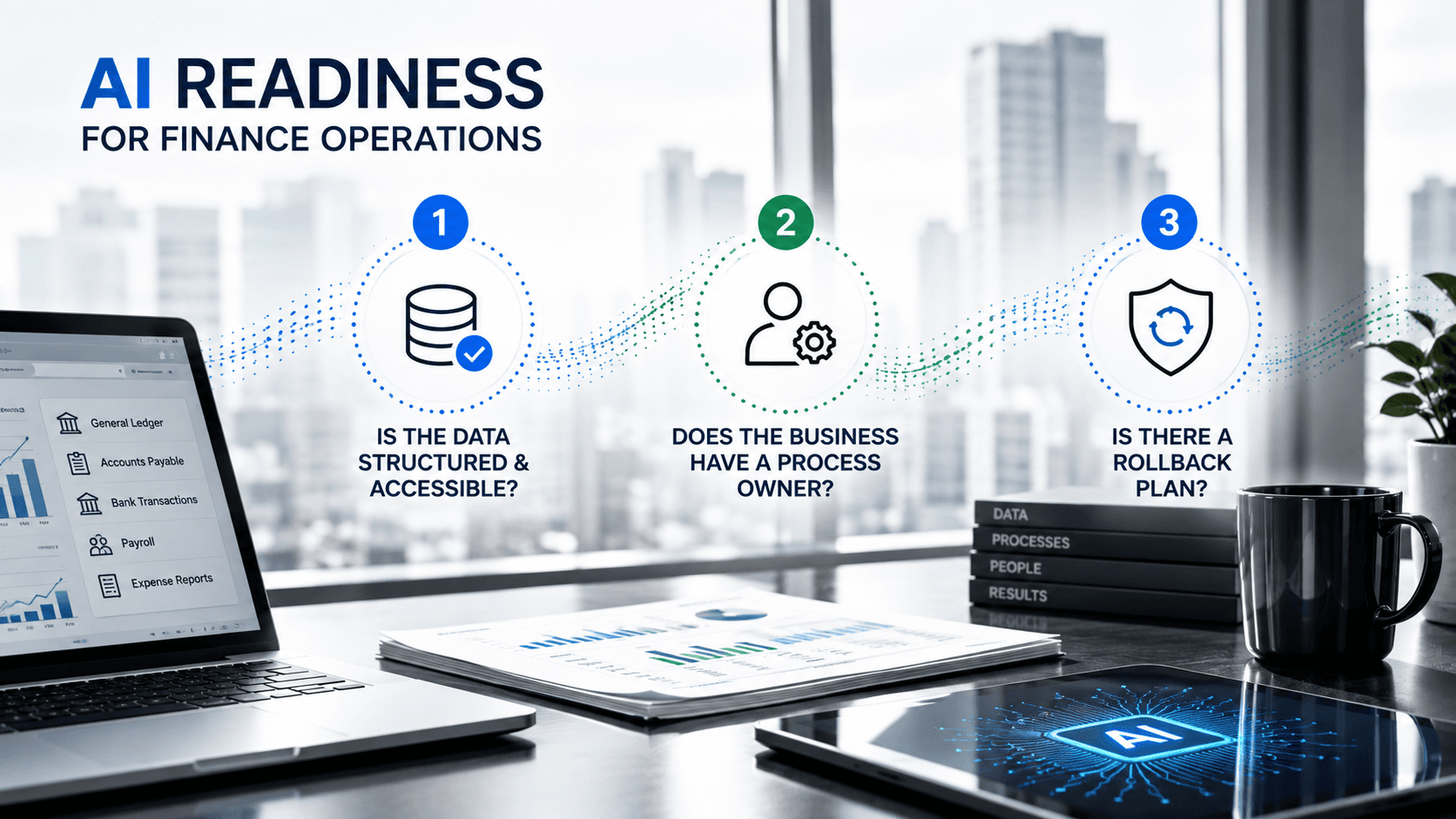
Before buying any AI seat or commissioning any AI project for the finance function, three diagnostic questions determine whether the investment has any chance of returning value. Most businesses that have stalled on AI pilots never asked them.
Question one — is the data structured and accessible? AI in finance operates on transactional data: general ledger entries, AP records, bank transactions, payroll, expense reports. Most businesses believe their data is clean. The actual condition, when examined, is usually one or more of: multiple systems with inconsistent chart of accounts, data living in spreadsheets rather than a managed source, a QuickBooks file not fully reconciled in twelve months, or an integration layer requiring manual intervention to function.
AI does not fix messy data. AI makes messy data produce confident-looking wrong answers faster. The readiness question is not "can we get data to the AI?" but "is the data we will give the AI valid enough that a wrong output would be caught before it caused harm?"
Question two — does the business have a process owner for the AI layer? Production AI is not a software deployment that IT manages. The AI layer sits between the source data and the GL. Someone in the finance function has to own the confidence thresholds, the exception routing, the audit trail, and the business rules embedded in the model. In most businesses, nobody owns this. The vendor sold the seat. The finance team uses the output. The AI layer operates without a named accountable owner.
Question three — is there a rollback plan? What does the business do when the AI output is wrong — demonstrably wrong on a Friday afternoon at month-end with an audit review scheduled Monday? If the answer is "we call the vendor," the business is not ready for production AI.
These three questions do not take a consulting engagement to answer. They take a conversation. The answers determine whether the AI purchase is an investment or an expense.