Part of: AI-native finance operations: what it actually means
The marketing version of "AI changes everything in finance" oversells the change. Four specific things change meaningfully. Four others change almost not at all.
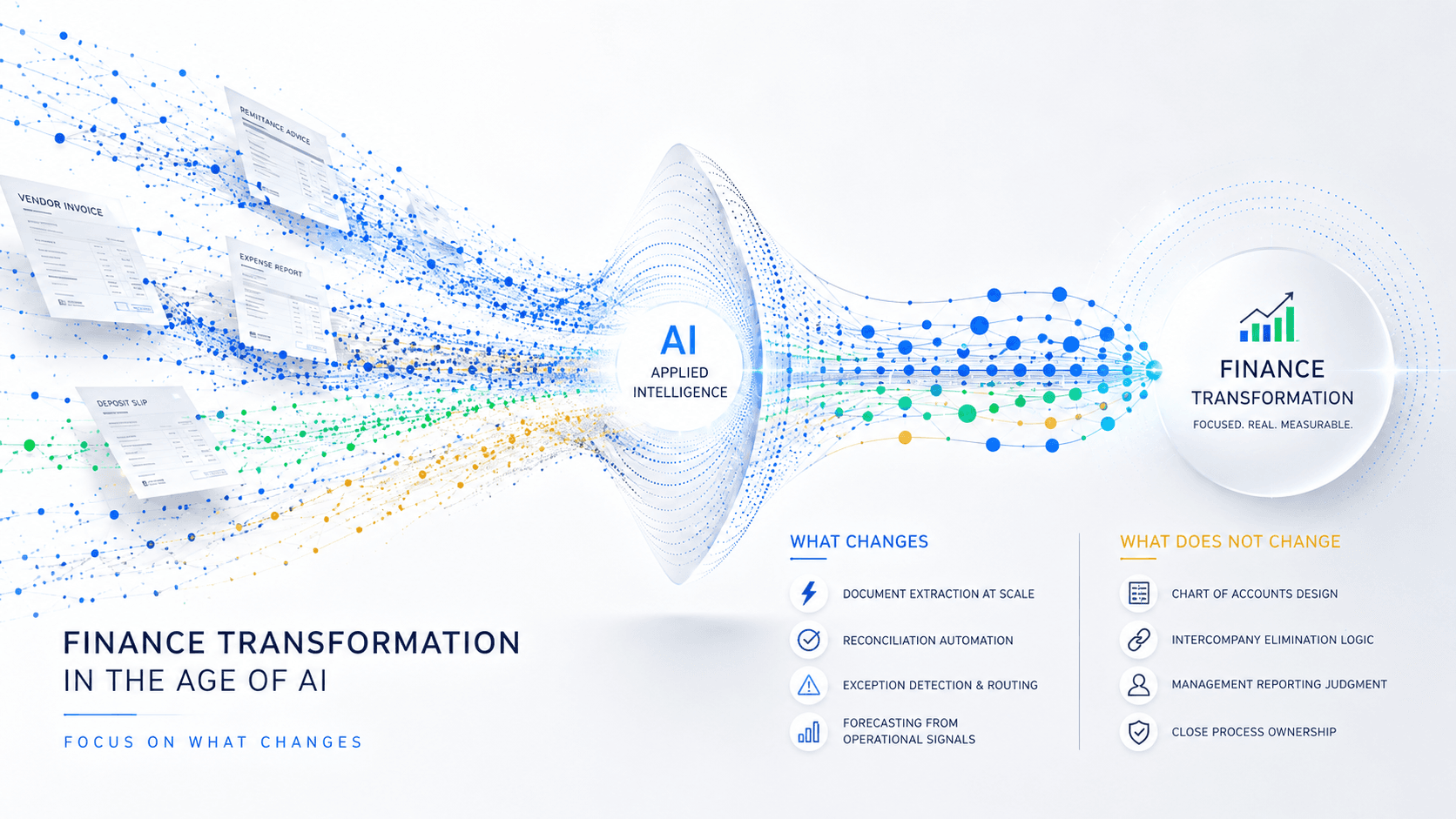
What AI materially changes.
Document extraction at scale. Vendor bills, payer remittance, expense reports, deposit slips. The work of converting unstructured documents into structured GL entries used to be the slowest step of the close cycle. AI-powered extraction with proper confidence scoring and exception routing collapses this. In a healthcare receivables operation running roughly fifty thousand invoices a month against six thousand-plus pages of remittance, the extraction phase that historically consumed days of staff time ran continuously throughout the month with hours of touch labor per cycle.
Reconciliation across high-volume transactional sources. Bank reconciliation, credit card matching, marketplace settlement reconciliation, intercompany matching. These are pattern-recognition workloads. AI-driven reconciliation routinely converts a five-day reconciliation phase to a six-hour one.
Exception detection and routing. AI models trained on transaction history surface anomalies — duplicates, coding inconsistencies, approval-bypass attempts — that rule-based systems miss. The exception queue gets smaller, not larger, as the model learns the business's patterns.
Forecasting from operational signals. Rolling cash forecasts and revenue projections that used to require analyst time now update from operational signals automatically.
What AI does not materially change.
Chart of accounts design. A poorly structured chart of accounts fed to an AI produces confident-looking wrong answers faster.
Intercompany elimination logic. The business rules for elimination are configuration work, not AI's domain.
Management reporting judgment. AI can produce the report. The CFO still decides what the report means.
Close process ownership. Production AI in finance requires a human who owns the confidence thresholds, the exception routing, and the audit trail. That accountability does not transfer to the model.
Filed under