Part of: AI-native finance operations: what it actually means
A healthcare network. $1.5B in annual revenue. 14 entities. 50,000 invoices per year across 6,000 pages of supporting documentation — EOBs, remittance advice, payer correspondence.
Three full-time AR staff. 47-day average collections cycle.
The before state: every document was read manually. A staff member would open an EOB, identify the payer, match it to outstanding AR, post the payment, and flag exceptions. For 50,000 invoices. Per year.
The problem wasn't headcount. They had enough people. The problem was that manual document review at that volume carries an irreducible error rate — mismatched postings, missed denial codes, exceptions sitting in a queue for 11 days before anyone touched them.
At 47 days average collections, the finance team was leaving approximately $2.3M in float at any given point.
What we built:
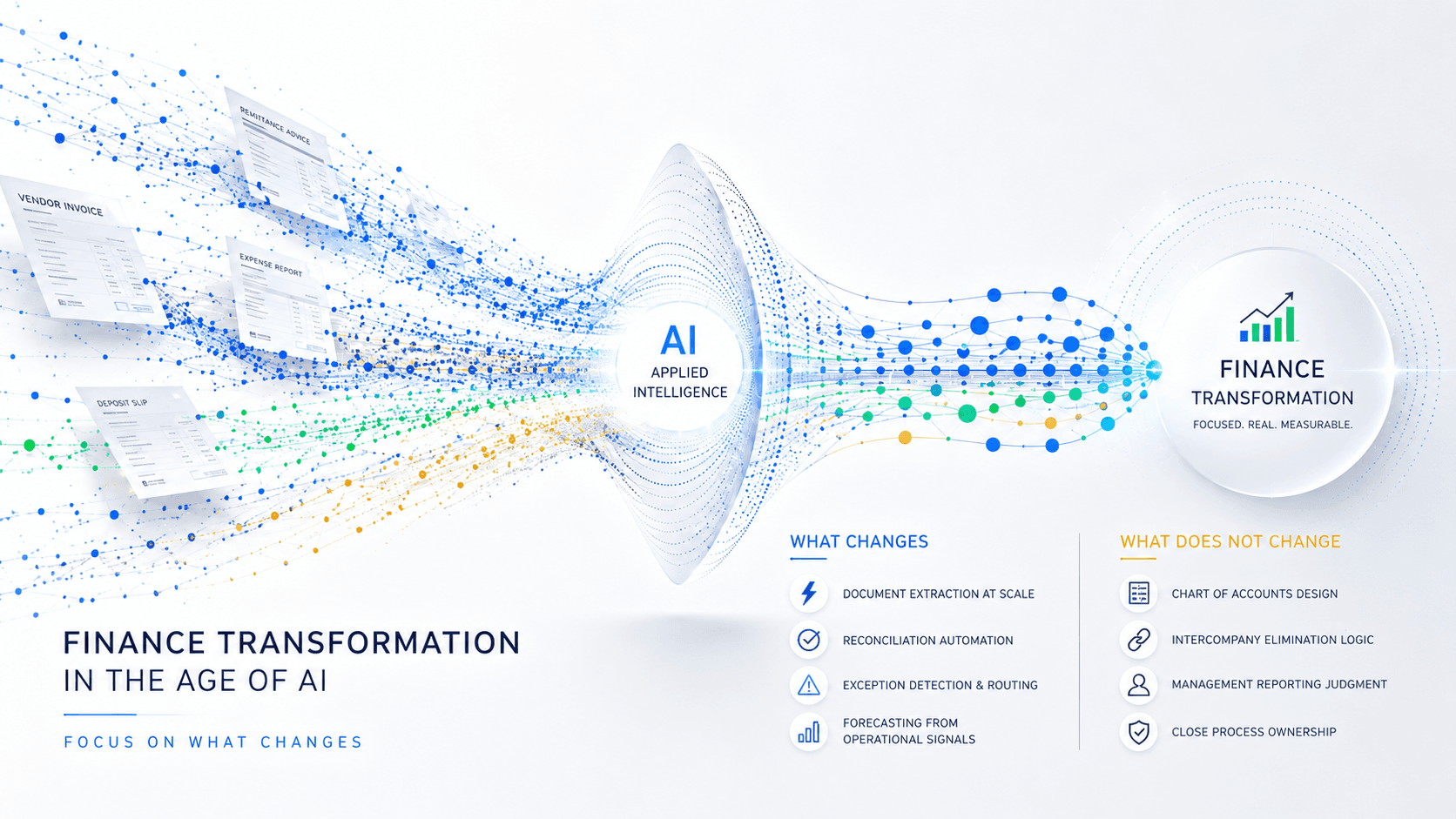
A document extraction pipeline that reads EOBs and remittance advice, identifies payer, payment amount, denial codes, and exception flags — then posts matched transactions automatically and routes everything below the confidence threshold to a human queue with a score attached.
Three decisions that made it work:
- We trained on their document corpus, not a generic model. Healthcare payer documents vary enough by payer that a general extraction model produces a 61% match rate. Client-specific training moved it to 91%.
- We built confidence scoring into every transaction. Every automated posting carries a score. Anything below 0.82 routes to the human queue. That threshold was calibrated against 6 months of historical data — not guessed, not defaulted.
- We deployed on the client's infrastructure. The data never leaves their environment. This resolved the compliance and audit questions in week one instead of month four.
Results at 90 days in production:
→ 91% of invoices processed without human review → Collections cycle: 47 days to 31 days → Exception queue clearance: 11-day average to 2.4 days → Denial catch rate up 34% — the model flags codes that manual review was missing entirely
The AR team didn't shrink. It shifted. Two of the three staff now manage exception escalations and payer relationship issues — work that actually requires judgment.
The 31-day collections cycle on $1.5B in revenue is worth approximately $4.1M in recovered float. The engagement covered its cost in the first billing cycle.
This is what a production AI deployment looks like. Not a pilot. Not a proof of concept. A system that runs, that has a confidence threshold, that has an audit trail, and that produces a number you can put in the board deck.
#ProductionAI #FinanceTransformation #HealthcareFinance