All insights
Digital & eCommerce

The eCommerce reconciliation problem nobody admits to — and the 90-day fix

Most multi-channel eCommerce businesses are running with a seven percent COGS variance against actual inventory movement, and a four-point gross margin error. The fix in ninety days is not a software purchase.

Published2 min read
The eCommerce reconciliation problem nobody admits to — and the 90-day fix
Digital & eCommerce2 min read
Share

The eCommerce reconciliation problem nobody admits to: most multi-channel businesses are running with a seven percent COGS variance against actual inventory movement, and a four-point gross margin error against what they think they earned. The CFO believes the financials. The board reviews them. The strategic decisions made on them are slightly wrong every quarter — and the cumulative error compounds for years until the audit forces a reset.

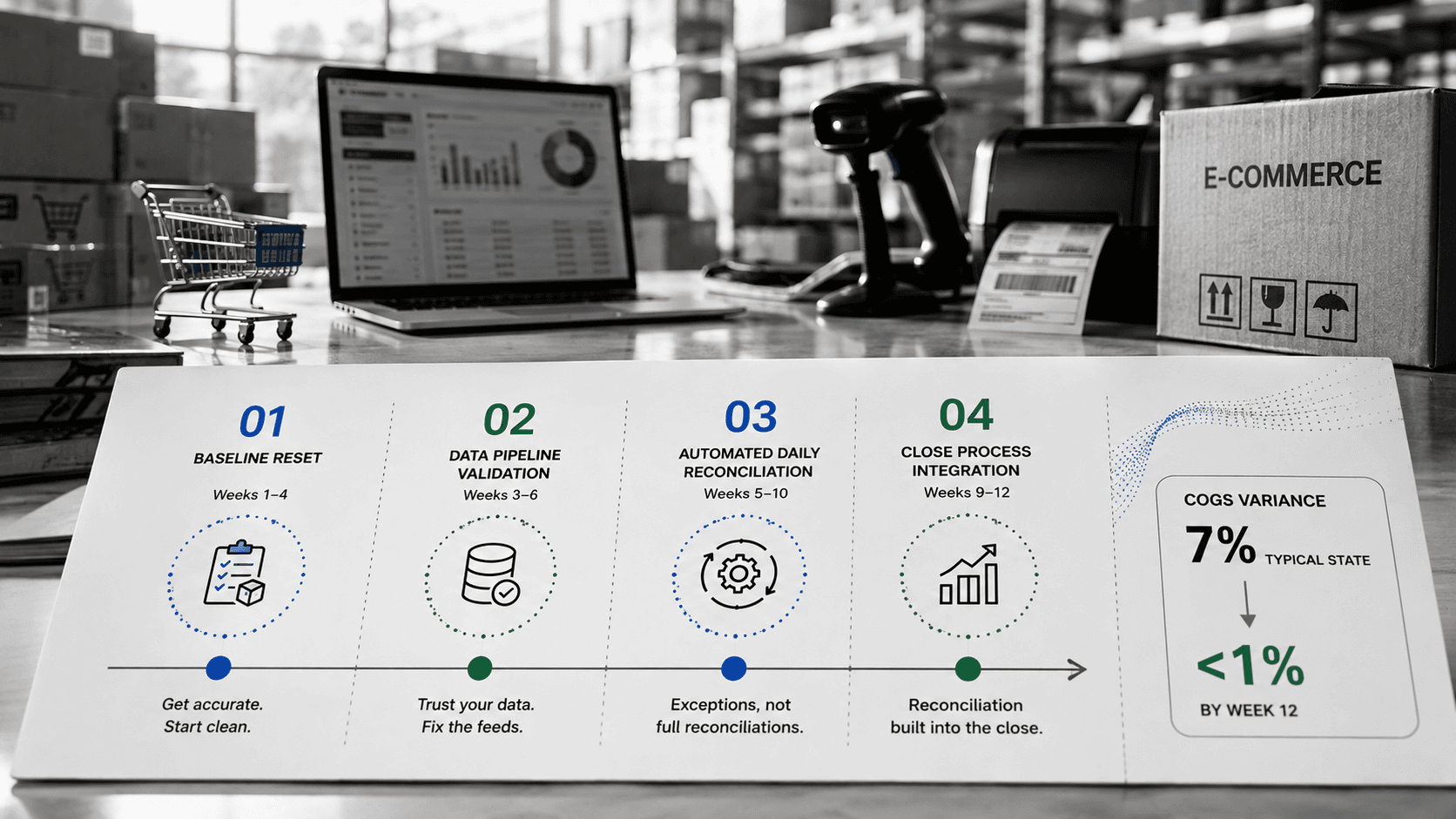
The fix in ninety days is not a software purchase. It is four sequenced phases.

Phase one — baseline reset (weeks one to four). The team performs a current-state count against perpetual inventory across every storage location: owned warehouse, FBA inventory, third-party logistics, retail returns. Marketplace platforms export the inventory positions they are reporting. The variances are reconciled and posted as a one-time adjustment. The locked baseline becomes the starting point for everything that follows.

Phase two — data pipeline validation (weeks three to six). Every data source feeding the inventory and revenue calculation is mapped and validated. Each integration is tested with known test transactions. Feeds that fail validation are corrected before reliance on automated reconciliation.

Phase three — automated daily reconciliation (weeks five to ten). With clean data sources and a validated baseline, daily automated reconciliation is configured to flag variances above a defined threshold. The team reviews exception queues, not full reconciliation runs.

Phase four — close process integration (weeks nine to twelve). The automated reconciliation output feeds directly into the close checklist. COGS is validated against inventory movement daily. The monthly close does not require a reconciliation project because the reconciliation has been running continuously.

The seven percent variance going in typically reaches below one percent by week twelve.

Continue Reading

More From the Insights Blog.

View all insights
AI integration in custom applications: the architecture choices that matter
Digital & eCommerce

AI integration in custom applications: the architecture choices that matter

Most custom applications with AI integration end up brittle because the AI was retrofitted, not architected. Four choices made at architectural design phase determine whether the integration is durable or brittle — and the retrofit penalty is three to five times original build cost.

Read post
Custom software vs SaaS: the decision framework that prevents three years of regret
Digital & eCommerce

Custom software vs SaaS: the decision framework that prevents three years of regret

Custom software versus SaaS gets argued on features the team needs and the price of the subscription. The actual decision is about reversibility and maintenance gravity — two factors that determine whether the choice produces three years of confidence or three years of regret. The math is structural; the wrong answer costs the rebuild plus eighteen to thirty-six months of operating on the wrong platform.

Read post
Multi-channel marketplace orchestration: the clearing-account architecture
Digital & eCommerce

Multi-channel marketplace orchestration: the clearing-account architecture

Multi-channel marketplace settlement is a structurally complex accounting problem that most eCommerce businesses solve with Excel and patience. Amazon sends a settlement that bundles sales, refunds, fees, advertising spend, FBA storage charges, and disbursements into a single deposit. eBay does the same with different structure. Walmart does it again with another. The accounting team unwinds the bundles manually every month and signs off the financials hoping nothing material slipped past.

Read post

Get Started

From Reading to Doing.

Every Best Practicify engagement begins with a 45-minute advisory session — a direct conversation with the practitioner who will lead the work, with enough information at the end to make a sound decision about whether the next step is a proposal, an RFP, or something else.