Part of: Why your month-end close keeps getting slower
Every controller I have worked with who has a slow close has also been asked, at some point, whether they need more staff. The answer is almost never yes.
I worked with a four-entity $30M business last year whose close ran twenty-four days. The team had grown from three to six accountants over the prior eighteen months. The close had gotten longer, not shorter.
The math looks like this: adding a staff accountant adds hours to the close because every new team member adds a reconciliation checkpoint, a sign-off step, a handoff, and a review loop. Headcount adds coordination cost. Coordination cost adds cycle time.
The close gets longer every quarter because the business itself is getting more complex — more entities, more intercompany transactions, more product lines, more exceptions — and the systems running the close were designed for an earlier version of the business. The team size is irrelevant to that structural mismatch.
The diagnostic is simple. Pull the last twelve monthly close logs and map each day to the category of work it represents. In almost every slow close I have analyzed, the same two or three structural bottlenecks account for eighty percent of the cycle time: intercompany matching, bank reconciliation across entities, and manual consolidation workbook assembly.
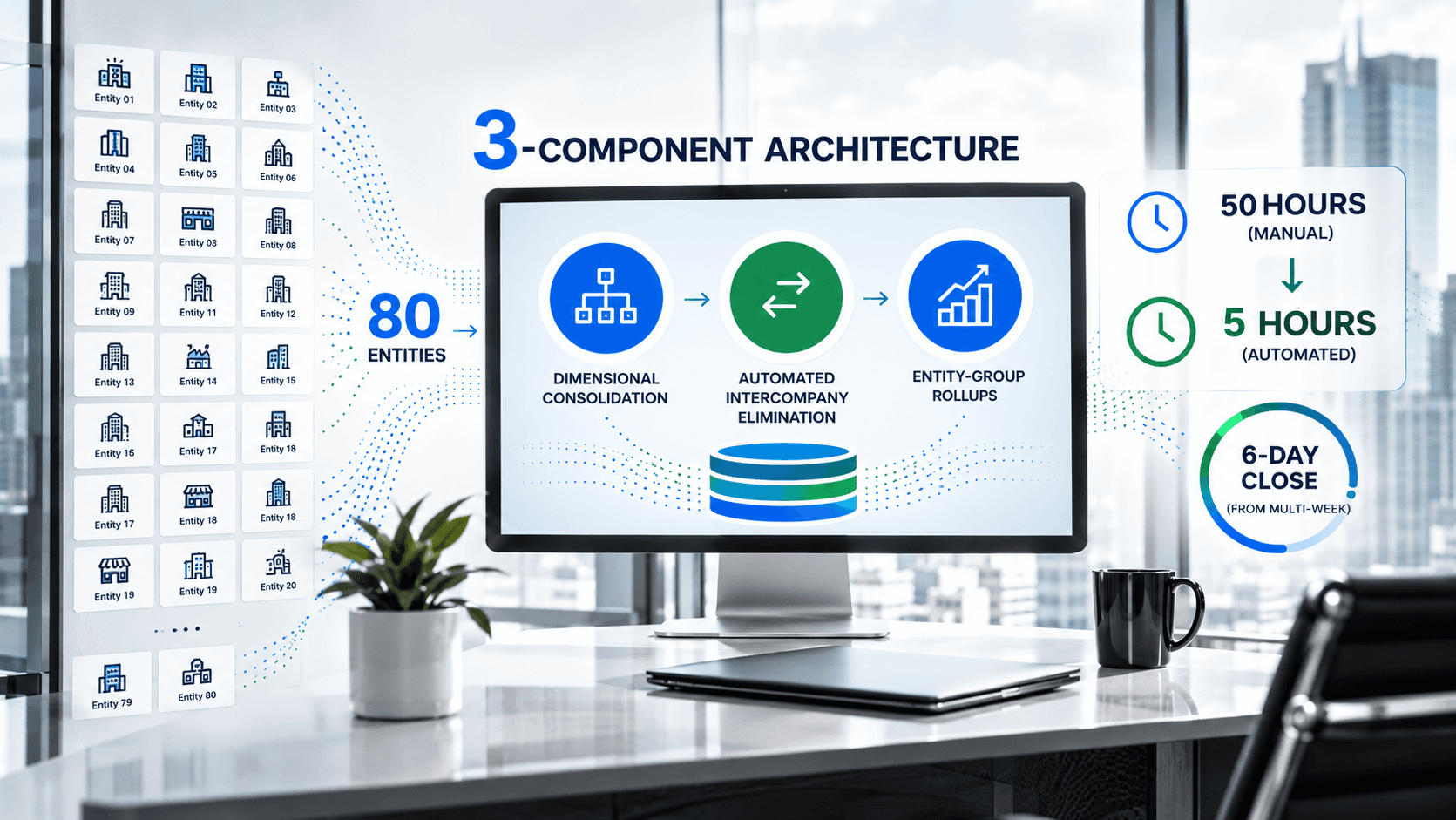
None of those bottlenecks are solved by adding staff. Intercompany matching is solved by automated elimination with consistent dimension tagging. Bank reconciliation is solved by daily bank feed integration with rule-based categorization. Consolidation is solved by native multi-entity ERP architecture that runs the rollup automatically.
The close compression is available. It requires architectural decisions, not hiring decisions.
If your close runs more than seven business days and the proposed fix involves headcount, the proposal is wrong. The architecture is the bottleneck — and it is fixable in a quarter, not a hiring cycle.
If your close takes longer every quarter, the cause is structural, not effort. See your Fragmentation Index.
→ See my Fragmentation Index | bestpracticify.co/scorecard
Filed under